
Dr. Agapitos Patakas
Chief Scientific Officer

 Insights
|
November 11, 2026
|
9 min read
With multiple therapies already approved, bispecific antibodies are an established approach to combining distinct binding specificities within one molecule. Bispecific and multispecific formats offer ways to improve responses, address resistance and engage more effective mechanisms, including redirecting immune cells to kill diseased cells.
Their development also reflects a strategic opportunity. Combining validated targets can build on established biology while creating a differentiated therapeutic with the potential for greater efficacy or benefit across a broader patient population. For developers, this can support a first-in-class programme and strengthen the rationale for investment, while reducing some of the uncertainty associated with pursuing entirely unvalidated biology.
However, validated targets do not guarantee a successful combination. Multiple binding specificities and the molecular architectures needed to accommodate them introduce challenges throughout development, from production and stability to binding characterisation and functional assessment. Developers need to establish how each specificity contributes, whether the combined molecule offers an advantage and whether it introduces unwanted activity.
At RoukenBio, we combine biophysical characterisation, custom cell engineering and functional assays to help developers answer them. This article explores how these approaches can test the rationale behind a bispecific or multispecific antibody, distinguish promising candidates and generate evidence to support further development.
A multispecific antibody's activity depends on both the targets it recognises and how the molecule is designed to engage them. Binding affinity, epitope selection, the number and arrangement of binding domains, and Fc properties all need to be considered when designing its characterisation strategy.
The starting point is the intended contribution of each specificity. An immune-cell engager needs to bring cells together in a way that supports effective killing. A dual-pathway inhibitor needs to demonstrate the contribution of both blocking activities. For a molecule designed to activate only when a second target is present, testing that dependency is central to establishing its selectivity.
The FDA guidance on bispecific antibody development recommends assessing the affinity and binding kinetics of each arm, whether simultaneous target engagement is necessary for activity, and the potential for synergy when both targets are bound. It also highlights quality attributes that may affect pharmacology, including avidity, potency, stability and product-related impurities such as aggregates or mispaired species.
The EMA guideline on monoclonal antibodies and related products applies its principles to bispecific antibodies on a product-specific basis. It recommends assessing biological activity through appropriate in vitro assays and evaluating effector functions, even when these are not part of the intended mechanism. It also explains why binding and functional assays are not necessarily interchangeable: molecular changes can preserve target binding while altering downstream activity.
In practice, the assay strategy should connect three questions:
- does each specificity bind as intended
- can the molecule engage its targets in the configuration required,
- and does this produce the expected functional benefit?
The strategy should also establish whether combining the specificities delivers the proposed advantage, whether greater activity, improved selectivity or a broader range of responsive cells. This provides a basis for selecting candidates and judging whether the evidence supports the molecule's development rationale.
Measuring the affinity of each binding specificity provides an essential baseline, but does not fully describe how a multispecific antibody engages its targets. Binding one target may alter access to another, while target abundance and spatial arrangement can influence the stability of the overall interaction. Characterisation needs to distinguish individual binding properties from the behaviour of the assembled molecule.
A bridging ELISA can demonstrate simultaneous engagement by capturing the antibody through one target and detecting its interaction with a second. Pei et al. (2022) describe this approach for a HER2/PD-L1 bispecific antibody , demonstrating its ability to bind both targets simultaneously. This establishes dual engagement under the assay conditions, but does not resolve how occupying one binding domain affects the kinetics of another interaction. Surface plasmon resonance (SPR) extends this analysis by monitoring binding in real time. Appropriately designed sequential or combined injections of binding partners can investigate whether occupying one binding domain changes another interaction.
The importance of assessing binding dependencies is illustrated by Meetze et al. (2023), who characterised CLN-978, a CD19/CD3 T-cell engager incorporating an albumin-binding domain for half-life extension. SPR data generated by RoukenBio showed approximately two- to threefold weaker affinity for CD19 and CD3 in the presence of albumin, primarily through slower association rates. These findings demonstrate why a specificity introduced for pharmacokinetic purposes also needs to be assessed for its influence on the therapeutic binding interactions.
Affinity describes an individual binding interaction. Avidity reflects the combined contribution of multiple interactions and depends on whether molecular geometry and target presentation allow those interactions to occur. On cells, target density, accessibility and co-expression can therefore influence antibody binding and retention.
This distinction matters when interpreting kinetic data. Slow dissociation from a densely expressing cell may reflect multivalent engagement and rebinding rather than stronger intrinsic affinity at an individual binding site. Measuring binding across controlled expression levels helps investigate these effects. For example in dual checkpoint formats, binding avidity in a target-dense context becomes the differentiating property. Pang et al. describe cadonilimab, a tetravalent Fc-null PD-1 x CTLA-4 bispecific that binds more avidly where both targets are present at high density, as in a tumour setting, and which shows minimal ADCC, ADCP and IL-6 and IL-8 release as a consequence of the Fc-null design.
RoukenBio combines heliXcyto single-cell interaction cytometry with IndEx-2 inducible expression systems to examine binding kinetics across different target densities. In a trastuzumab–HER2 study, we measured binding to fixed CHO cells with quantified HER2 expression. This approach allows expression-dependent changes in binding amplitude and kinetic behaviour to be investigated, providing a basis for assessing avidity effects.
Dual-inducible systems extend this approach to independently controlling two targets, enabling studies of how their relative abundance and co-expression influence multispecific antibody engagement.
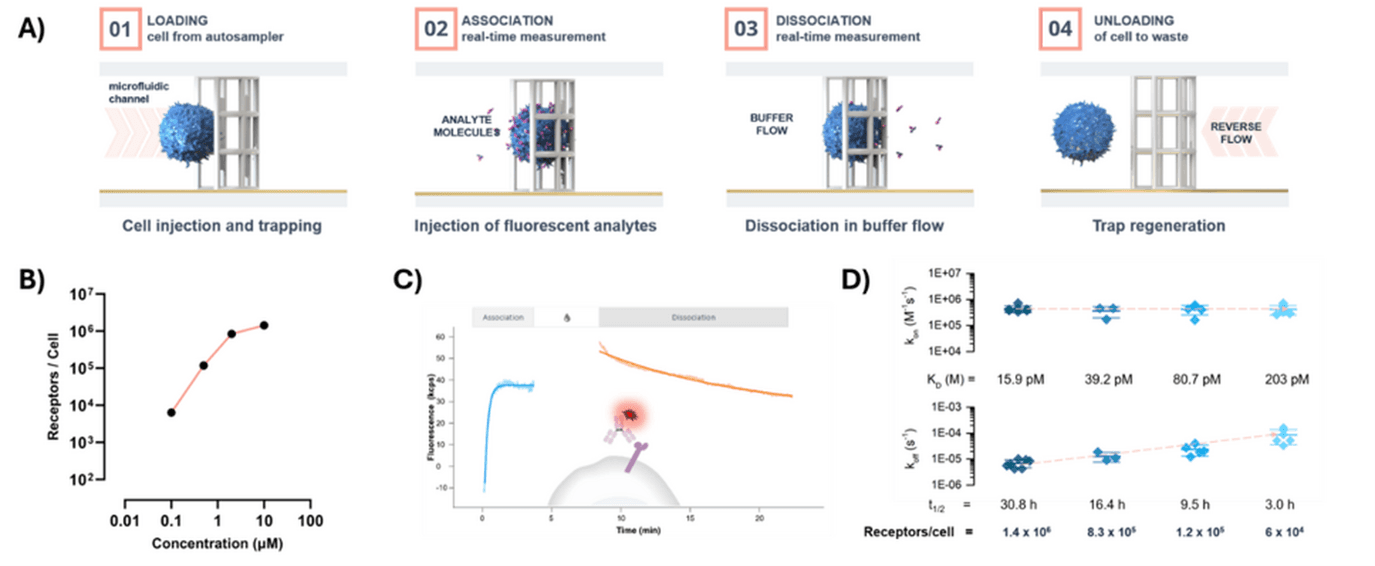
Figure 1. Single-cell interaction cytometry (scIC) measures antibody binding in real time (A). Combining titratable HER2 expression (B) with trastuzumab binding measurements (C) revealed slower dissociation at higher receptor abundance, with similar association rates (D). This is consistent with increased avidity, highlighting the relevance of antigen abundance to antibody binding.
For immune-cell engagers, binding needs to support an interaction between effector and target cells. Cell avidity measurements using platforms such as Avidion assess the overall strength of cell–cell attachment under applied force, helping investigate how molecular design, engager concentration and target density influence cellular engagement.
The rationale is illustrated by work examining T-cell engagers with different combinations of CD3 and tumour-target affinities. Their reported observations suggest that cellular engagement depends on the combined properties of both binding arms, with increases in individual affinity not translating proportionally into stronger cell attachment.
Combining cell avidity measurements with activation and cytotoxicity assays can help establish how these differences in engagement relate to functional outcomes. This adds a layer of characterisation between molecular binding analysis and assessment of immune-mediated killing.
A multispecific antibody may combine activities that require different biological conditions to become apparent. Demonstrating one activity does not establish that the others remain functional within the assembled molecule. Characterisation therefore needs to assess the contribution of each intended mechanism and, where possible, the effect of combining them.
The assay strategy depends on the combination. A molecule blocking two cytokines may require separate pathway-specific assays, followed by a model in which both contribute to the response. Combining checkpoint blockade with co-stimulation requires conditions that support both inhibitory signalling and the co-stimulatory response. For checkpoint and VEGF blockade, complementary immune and vascular assays may be more informative than attempting to capture both activities in a single system. For co-stimulatory formats, the readouts are the ones that report T cell quality rather than target cell death. Muik et al. characterised a PD-L1 x 4-1BB bispecific, which combines PD-L1 blockade with conditional 4-1BB stimulation, in human T cell cultures measuring proliferation, cytokine production and antigen-specific cytotoxicity, benchmarked against approved PD-1 and PD-L1 antibodies.
At RoukenBio, we develop assay systems around these mechanistic requirements. Custom reporter cell lines provide measurable readouts of specific signalling pathways, while engineered target cells allow receptor expression and co-expression to be controlled. These tools support assessment of individual activities and the development of assays that investigate their combined effects. RoukenCells provides access to reporter and inducible cell lines, alongside custom cell engineering where the required model is not available.
Multi-targeting antibody–drug conjugates introduce a related distinction: multiple binding specificities may support a shared mechanism of payload delivery. Here, characterisation needs to establish how each target contributes to cellular uptake and cytotoxicity, including activity in cells expressing either target alone or both together.
An integrated assay is useful when the model supports the relevant mechanisms and the readouts allow their contributions to be interpreted. Otherwise, a strong overall response could conceal a weak or inactive component. RoukenBio combines engineered cell systems with complex primary-cell assays and co-cultures to investigate these contributions. Where the question depends on tissue organisation or interactions within the disease environment, tumoroid and explant models can provide an additional level of assessment, selected according to the biology they retain.
Immune-cell engagers need to establish contact between effector and target cells and trigger an effective response. Functional characterisation therefore needs to connect target-cell killing with the immune activation that drives it, while establishing the conditions under which unwanted activity can occur.
For T-cell engagers, purified CD8+ cells provide a focused assessment of cytotoxic activity, whereas pan-T-cell populations incorporate contributions from both CD4+ and CD8+ subsets. Exhausted T-cell models and tumour-infiltrating lymphocytes (TILs) address further questions about activity in populations whose functional state differs from healthy peripheral-blood T cells.
RoukenBio offers these complementary systems through its T-cell assay capabilities, allowing studies to progress from controlled assessment of redirected killing to investigation of activity in more challenging immune contexts. Killing can be measured alongside activation, proliferation and cytokine release, with donor selection and cell preparation considered when interpreting differences between candidates.
Effector selection is equally important for engagers targeting other immune receptors. Gauthier et al. (2019) described multifunctional NK-cell engagers targeting a tumour antigen together with NKp46 and CD16, illustrating how a molecule can recruit several activating interactions within one effector population. Vallera et al. describe a trispecific killer engager combining anti-CD16 and anti-CD33 with a modified interleukin-15 crosslinker, characterised by NK cytotoxicity, degranulation and cytokine production alongside NK cell survival and proliferation, the last two being the readouts the cytokine arm was added to influence.
CD16-directed molecules may also engage CD16-expressing γδ T-cell populations, while potential interactions with neutrophils depend on receptor isoform recognition and cellular context. These populations differ in their activation requirements and effector mechanisms, so receptor expression alone is insufficient to predict the response. RoukenBio's NK-cell assays and γδ T-cell capabilities support investigation of alternative effector populations, with readouts selected to capture the intended mechanism.
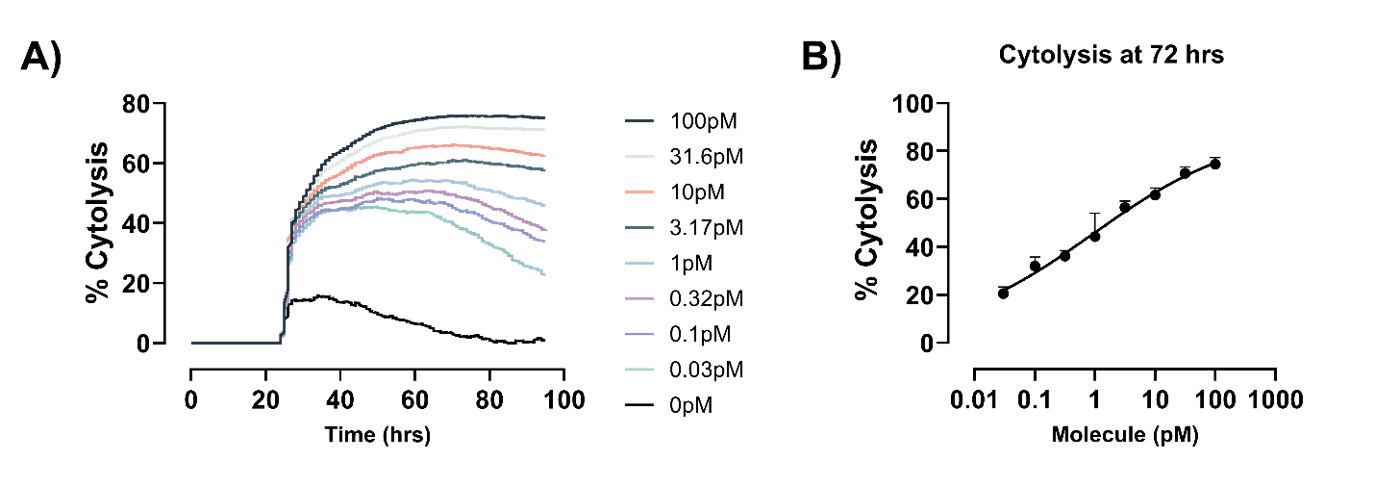
Figure 2. Assessment of innate cell engager activity using expanded Vγ9Vδ2 T cells. Expanded Vγ9Vδ2 γδ T cells were co-cultured with a cancer cell line at an effector-to-target ratio of 10:1 in the presence of an innate cell engager. Target-cell responses were monitored in real time using the xCELLigence impedance-based platform. Data are anonymised; the molecule and target-cell line identities are undisclosed.
Target-cell selection has an equally important influence on assay interpretation. Cancer cell lines provide reproducible models, but differ in antigen expression, susceptibility to killing and other biological features. Comparing unrelated lines can therefore reveal differences in response without establishing which feature causes them.
The importance of antigen density is illustrated by Meetze et al. (2023), who investigated CLN-978 activity using cells with controlled CD19 expression. Their findings showed that the relationship between antigen density and killing depended on engager concentration, demonstrating why potency needs to be interpreted in the context of target expression. Antigen density also offers a route to selectivity. Where a tumour antigen is also present on normal tissue at lower levels, a format binding the tumour antigen with two low-affinity arms can achieve avidity-driven preference for high-density cells, an approach described for an anti-HER2/CD3 bispecific by Slaga et al. as a way of reducing on-target off-tumour activity.
RoukenBio's IndEx-2 inducible expression systems allow antigen density to be varied within the same cellular background. Incorporating these cells into functional assays enables investigation of the expression levels at which killing, immune activation and cytokine release emerge. Dual-inducible systems extend this approach to testing the contribution of two targets and their co-expression.
These measurements help define functional thresholds and distinguish activity against high- and low-expressing targets. They inform both efficacy and safety questions, although activity against engineered low-expressing cells needs to be complemented by relevant normal-cell models when investigating on-target, off-tumour effects.
Immune-cell engager activity depends on more than target expression. Tumour-cell susceptibility to killing, the functional state of resident lymphocytes and stromal interactions can all influence the response. Patient-derived models allow these factors to be investigated in systems that retain aspects of tumour heterogeneity and the local microenvironment.
RoukenBio's matched colorectal cancer (CRC) biobank comprises tumoroids, autologous tumour-infiltrating lymphocytes (TILs) and cancer-associated fibroblasts. Tumoroid–TIL co-cultures enable assessment of redirected killing using tumour and effector cells from the same patient, while adding or removing matched fibroblasts allows the stromal contribution to be examined. Comparing these configurations, alongside measurements of tumour-cell death and immune-cell function, can help investigate whether limited activity reflects effector dysfunction, tumour-cell resistance or stromal influences.
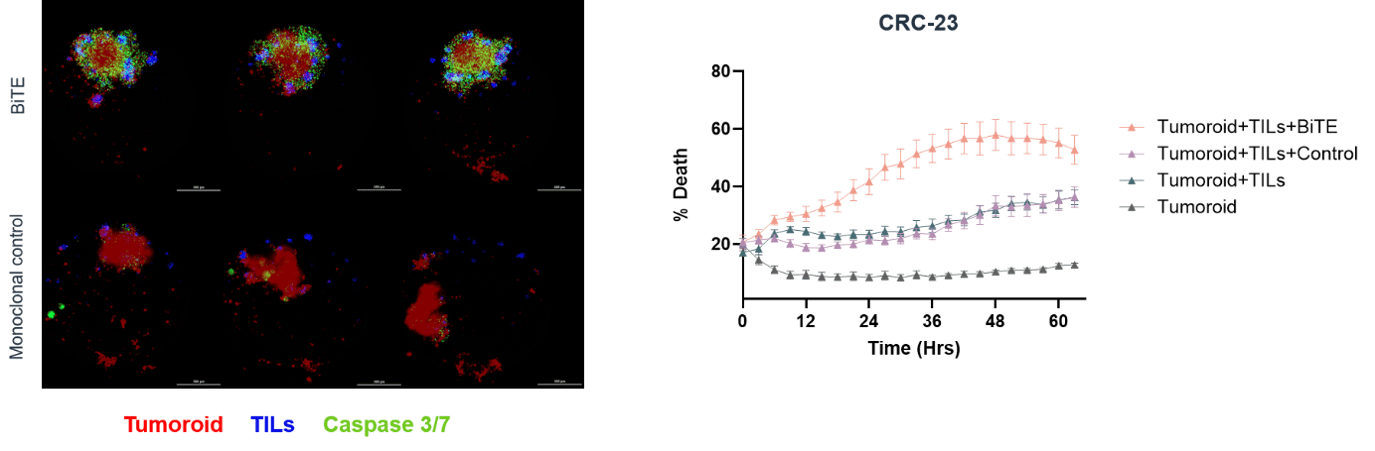
Figure 3. Bispecific T-cell engager activity in patient-derived colorectal cancer tumoroids co-cultured with autologous TILs. Representative fluorescence images show tumoroids (red), tumour-infiltrating lymphocytes (TILs; blue) and caspase-3/7 activity (green), indicating apoptosis, following treatment with a bispecific T-cell engager (BiTE) or a monoclonal control. The graph shows the time course of percentage cell death in the CRC-23 model for tumoroids cultured alone or with autologous TILs, with or without BiTE or control treatment.
Characterisation of these banks is critical to interpreting functional responses. Linking genetic and transcriptional profiles with clinical metadata allows observed sensitivity or resistance to be investigated in the context of tumour biology and, where available, treatment history. Characterised biobanks therefore enable selection of biologically relevant cohorts, investigation of response heterogeneity and identification of candidate biomarkers for further validation.
These reconstructed systems allow control over cellular composition, but expansion and reassembly can alter cell states and spatial relationships. Tissue explants offer a complementary approach by retaining malignant, immune and stromal components within the original tissue architecture during short-term culture. They are particularly useful when activity depends on resident immune populations and local signals that may be lost during cell isolation.
Kaptein et al. (2024) illustrate this principle using patient-derived tumour fragments to investigate CD8-targeted IL-2. Although treatment enhanced the effector capacity of intratumoral CD8+ T cells, functional reactivation of dysfunctional tumour-reactive cells required concurrent antigen recognition. The tissue model therefore helped distinguish delivery of a cytokine signal from the antigen-dependent response it enabled.
Model selection should follow the mechanism under investigation. Reconstructed co-cultures allow individual cellular contributions to be tested, whereas explants assess activity within an existing tissue environment. Explant interpretation nevertheless depends on tissue viability, sampling heterogeneity and the limited culture window; recruitment of circulating immune cells is not reproduced. RoukenBio's clinical network supports access to patient tissues, with tissue explant assays already offered for inflammatory bowel disease (IBD).
The mechanisms that drive multispecific antibody activity can also create safety liabilities. For immune-cell engagers, effective target-dependent activation may produce substantial cytokine release, while recognition of the same antigen on healthy cells can cause on-target, off-tumour injury. Immunogenicity represents a separate consideration across multispecific formats, requiring assessment of the molecule's potential to induce an anti-drug immune response.
Cytokine release should be interpreted alongside target-cell killing and effector activation. Concentration–response and time-course measurements help establish whether cytotoxic activity is accompanied by disproportionate inflammatory responses. Target-negative cells, conditions without target cells and appropriate binding-deficient controls can investigate whether activation requires the intended molecular interactions. However, demonstrating target dependence does not eliminate cytokine release syndrome (CRS) risk: inflammatory responses can arise from the intended pharmacology itself.
Cellular composition is particularly important. Purified effector–target co-cultures provide mechanistic resolution but may exclude accessory cells that amplify inflammatory signalling. PBMC and whole-blood assays offer complementary contexts, with soluble or immobilised presentation selected according to the interactions being investigated. RoukenBio's cytokine release assays incorporate these formats and multi-analyte cytokine measurements across human donors. The results support candidate comparison and identification of activation mechanisms; they do not directly predict the incidence or severity of clinical CRS.
Fc inclusion introduces additional interactions that may support or interfere with the intended mechanism. For CD3-engaging molecules, Fcγ receptor binding can provide an alternative route to cross-linking T cells with myeloid or other Fcγ receptor-expressing cells. Comparing Fc-active and Fc-silenced variants, or applying Fcγ receptor blockade in an appropriate cellular system, can help establish this contribution. Experimental work on T-cell-engaging bispecifics has demonstrated effects of Fc function on cytokine release, T-cell distribution and antitumour activity, illustrating why Fc design needs functional assessment beyond receptor-binding measurements.
The relevant question is whether Fc activity is required, tolerated or unwanted for the particular molecule. Fc-free formats remove Fc-mediated interactions but retain risks arising from their binding specificities and immune-activating mechanisms.
Assessment of on-target, off-tumour activity builds on the antigen-density studies described above. Controlled expression systems identify conditions under which activity emerges, while relevant primary non-malignant cells test whether those findings translate to healthy-cell contexts. Target accessibility, co-expression and susceptibility to injury also matter, so antigen density alone cannot establish a therapeutic window.
Multispecific engineering can introduce novel sequences, linkers and domain junctions, while molecular stability and aggregation can influence immune recognition. These features warrant assessment without assuming that a more complex architecture is necessarily more immunogenic.
Complementary approaches address different stages of the immune response. Sequence-based analysis can identify potential HLA class II-binding peptides; antigen-presentation studies can investigate which peptides are processed and presented; and donor-based CD4+ T-cell assays can assess activation and proliferation. Joubert et al. (2016) demonstrated the value of comparative human donor assays for investigating the relative immunogenic potential of antibody therapeutics. Such studies support risk assessment and candidate selection rather than providing a direct estimate of clinical anti-drug antibody incidence.
RoukenBio's immunogenicity assessments include dendritic-cell maturation and T-cell activation assays, with donor selection, HLA coverage and benchmark molecules informing interpretation. For immune-modulating candidates, assay design must also distinguish direct pharmacological activation from responses to the therapeutic protein as an antigen. These preclinical assessments are distinct from anti-drug antibody assays, which detect and characterise antibody responses in samples collected following exposure.
In vitrocharacterisation contributes to development when it establishes which models are informative, which liabilities require further investigation and how biological activity relates to exposure. For multispecific antibodies, this requires an understanding of the assembled molecule: cross-reactivity of individual binding domains does not necessarily establish that a species reproduces their combined pharmacology.
Comparative binding and functional studies support assessment of species relevance, as outlined in ICH S6(R1). For a multispecific, these comparisons should address each specificity and the interactions required for activity. An immune-cell engager may recognise both species orthologues yet produce a different response because of differences in target distribution, receptor expression or effector-cell biology. Functional comparisons help establish whether the proposed model can reveal adverse consequences of the intended mechanism.
The same data can inform nonclinical study design. Findings on normal-cell activity, Fc-dependent interactions and cytokine release help identify relevant endpoints and pharmacodynamic markers. Where a model reproduces only part of the molecule's activity, that limitation needs to remain explicit when interpreting an absence of toxicity. Human-cell assays provide complementary evidence for mechanisms that are poorly represented in the selected species.
Human-cell concentration–response data also contribute to the first-in-human starting-dose rationale. Binding, receptor occupancy and functional responses can inform estimation of the minimum anticipated biological effect level (MABEL), where appropriate, when integrated with pharmacokinetic modelling and the wider nonclinical evidence. The EMA guideline on first-in-human and early clinical trials emphasises this integrated assessment. An isolated EC50 is insufficient: assay context, donor variability and the relationship between experimental concentrations and anticipated human exposure all influence interpretation.
RoukenBio's comparative binding and cell-based functional studies contribute to this evidence base, connecting molecular characterisation with species relevance and human pharmacology. Within an IND or CTA submission , their value lies in supporting the rationale for model selection and clinical progression while defining the uncertainties that remain.
Effective characterisation of a multispecific antibody connects molecular binding with the biological response the complete molecule is designed to produce. The assay strategy should establish the contribution of each specificity, investigate their combined activity and identify the cellular conditions that influence efficacy and safety. Controlled systems provide mechanistic resolution, while patient-derived models test whether those findings hold across more diverse biological contexts.
RoukenBio brings together biophysical analysis, custom cell engineering, primary immune-cell assays and characterised patient-derived models to address these questions. Discuss your programme with our team to develop an assay strategy that resolves the uncertainties most important to your next development decision.
A bispecific antibody is an engineered antibody that binds two different targets rather than one. The most common application is bringing an immune effector cell into contact with a tumour cell by binding an antigen on each, though bispecific formats are also used to block two pathways at once or to combine blockade with co-stimulation. The two binding arms may have very different affinities, depending on what the design is intended to achieve.
Explore our range of human-relevant in vitro assays and scientific capabilities designed to generate meaningful data throughout your research programme.


Access our Capabilities brochure
Insights
 Webinars
🗓️ Stay informed with our monthly scientific newsletter, published on LinkedIn on the last Wednesday of each month.
These editions bring you the latest in drug development breakthroughs, industry trends, and expert insights from the brilliant minds at RoukenBio.
Subscribe today on LinkedIn
 Research Posters