Bethany Weston
Study Scientist

 Research Posters
|
April 13, 2026
|
4 min read
LocIn is a high-fidelity targeted integration platform that enables rapid, high‑quality generation of isogenic mammalian cell lines, eliminating the need for subcloning and significantly reducing development time. By standardising integration patterns, LocIn removes positional effects to support reliable genotype‑phenotype assessments and toxicology species cross‑reactivity studies. Single and multiplatform systems provide controlled low or high expression, ensuring consistent, integration and artefact-free cell lines for robust experimental comparison.
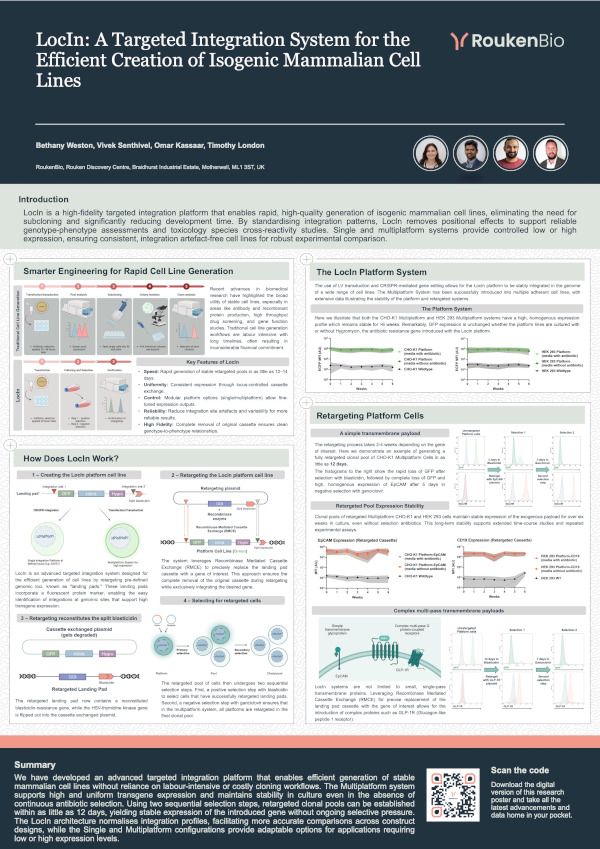
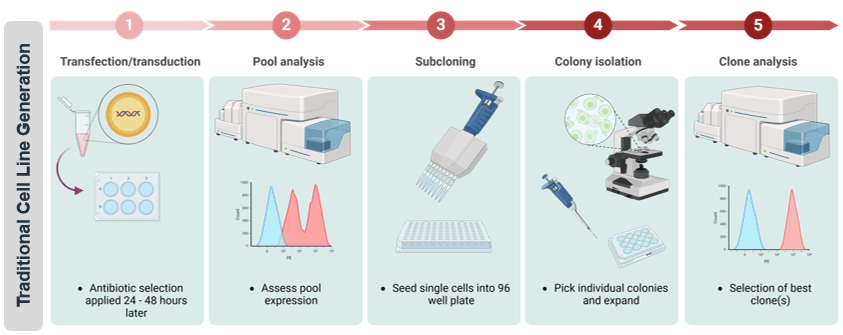
Recent advances in biomedical research have highlighted the broad utility of stable cell lines, especially in areas like antibody and recombinant protein production, high throughput drug screening, and gene function studies. Traditional cell line generation workflows are labour intensive with long timelines, often resulting in inconsiderable financial commitment.
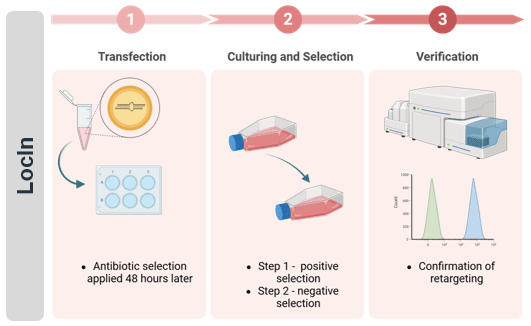
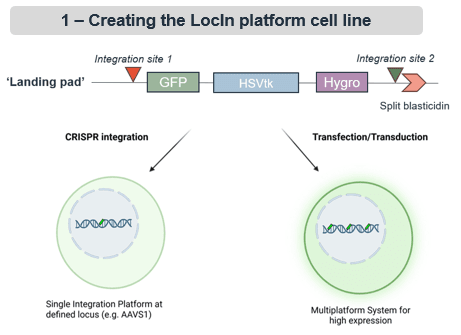
LocIn is an advanced targeted integration system designed for the efficient generation of cell lines by retargeting pre-defined genomic loci, known as "landing pads." These landing pads incorporate a fluorescent protein marker, enabling the easy identification of integrations at genomic sites that support high transgene expression.
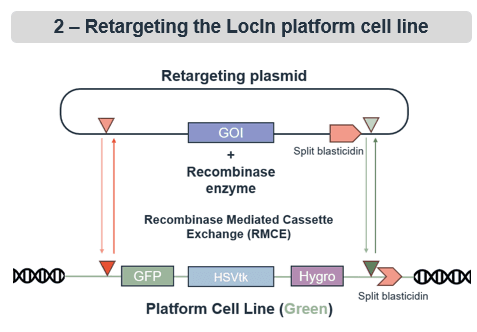
The system leverages Recombinase Mediated Cassette Exchange (RMCE) to precisely replace the landing pad cassette with a gene of interest. This approach ensures the complete removal of the original cassette during retargeting while exclusively integrating the desired gene.
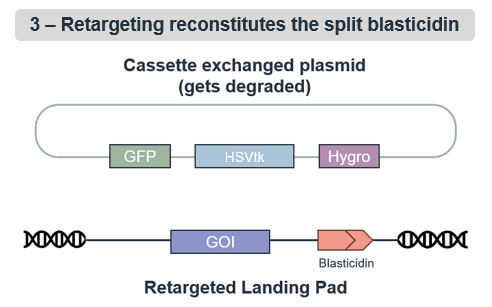
The retargeted landing pad now contains a reconstituted blasticidin-resistance gene, while the HSV-thymidine kinase gene is flipped out into the cassette exchanged plasmid.
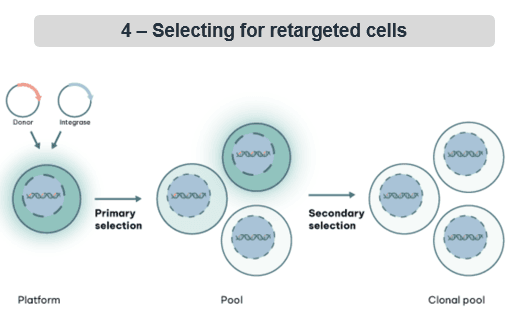
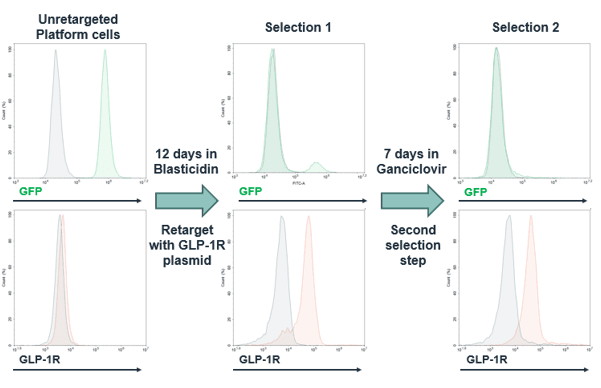
The retargeted pool of cells then undergoes two sequential selection steps. First, a positive selection step with blasticidin to select cells that have successfully retargeted landing pads. Second, a negative selection step with ganciclovir ensures that in the multiplatform system, all platforms are retargeted in the final clonal pool.
The use of LV transduction and CRISPR-mediated gene editing allows for the LocIn platform to be stably integrated in the genome of a wide range of cell lines. The Multiplaform System has been successfully introduced into multiple adherent cell lines, with extensive data illustrating the stability of the platform and retargeted systems.
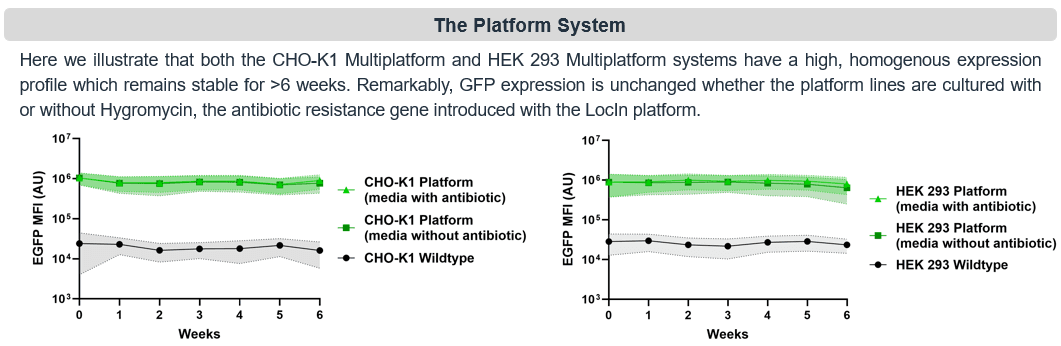
The retargeting process takes 2-4 weeks depending on the gene of interest. Here we demonstrate an example of generating a fully retargeted clonal pool of CHO-K1 Multiplatform Cells in as little as 12 days.
The histograms below show the rapid loss of GFP after selection with blasticidin, followed by complete loss of GFP and high, homogenous expression of EpCAM after 5 days in negative selection with ganciclovir.
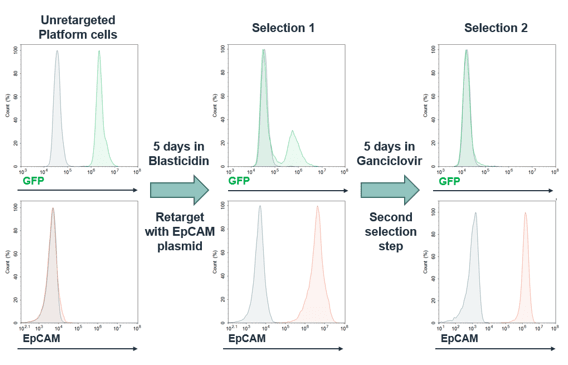
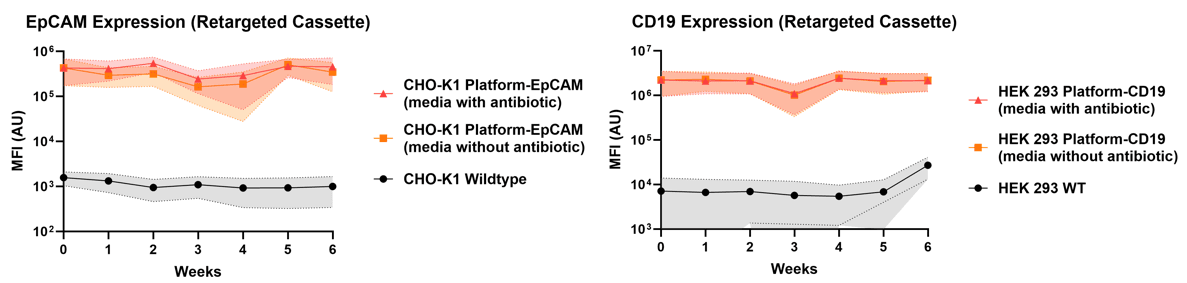
Clonal pools of retargeted Multiplatform CHO-K1 and HEK293 cells maintain stable expression of the exogenous payload for over six weeks in culture, even without selection antibiotics. This long-term stability supports extended time-course studies and repeated experimental assays.
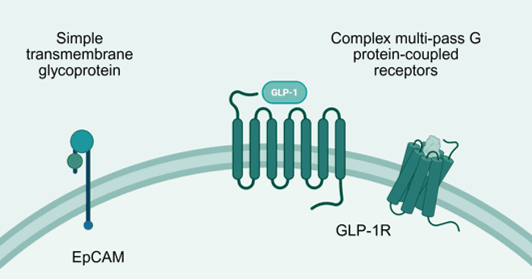
LocIn systems are not limited to small, single-pass transmembrane proteins. Leveraging Recombinase Mediated Cassette Exchange (RCME) for precise replacement of the landing pad cassette with the gene of interest allows for the introduction of complex proteins such as GLP-1R (Glucagon-like peptide 1 receptor).
We have developed an advanced targeted integration platform that enables efficient generation of stable mammalian cell lines without reliance on labour-intensive or costly cloning workflows. The Multiplatform system supports high and uniform transgene expression and maintains stability in culture even in the absence of continuous antibiotic selection. Using two sequential selection steps, retargeted clonal pools can be established within as little as 12 days, yielding stable expression of the introduced gene without ongoing selective pressure. The LocIn architecture normalises integration profiles, facilitating more accurate comparisons across construct designs, while the Single and Multiplatform configurations provide adaptable options for applications requiring low or high expression levels.
🗓️ Stay informed with our monthly scientific newsletter, published on LinkedIn on the last Wednesday of each month.
These editions bring you the latest in drug development breakthroughs, industry trends, and expert insights from the brilliant minds at RoukenBio.
Subscribe today on LinkedInFind out more about how LocIn works and how it could transform your cell engineering needs.