
Dr Robert Benson
Scientific Director of Immunology

Dr Shatakshi Sood
Associate Scientific Director, Allergy

 Insights
|
November 20, 2026
|
8 min read
Allergic disease results from the interaction of allergen‑specific adaptive immunity, IgE‑dependent effector‑cell activation, type 2 inflammation and responses within the affected tissue. The expanding range of therapeutics directed against these pathways has increased the need for biologically relevant experimental platforms capable of resolving both target engagement and downstream functional activity.
For therapeutics targeting IgE‑mediated effector responses, this requires experimental systems that recapitulate FcεRI‑dependent activation within an appropriate cellular context. Basophil activation tests (BAT), human mast‑cell systems and human FcεRI‑expressing rat basophilic leukaemia (RBL) reporter cells provide complementary approaches to interrogate this biology, from donor‑specific responses in whole blood to controlled assessment of IgE-FcεRI signalling and effector‑cell activation. These systems form part of a broader experimental landscape in which Th2 and B‑cell responses, cytokine signalling and tissue‑associated inflammation can be interrogated according to the mechanism of the therapeutic under investigation.
The increasing application of functional bioassays in allergy has brought greater emphasis on assay standardisation, reproducibility and biological interpretation. A recent European Academy of Allergy and Clinical Immunology (EAACI) position paper highlights these considerations in the context of translating allergy bioassays towards clinical implementation (Karaaslan et al.). Although its focus is clinical, the underlying principles are equally pertinent to therapeutic research: an assay is informative only when it reproducibly measures a biological response relevant to the mechanism under investigation.
Against this background, this article considers the experimental approaches available to investigate allergy therapeutics, with particular emphasis on IgE‑mediated effector biology. It examines how BAT, human mast‑cell and RBL systems differ in the biology they reproduce and the questions they can address; how therapeutics targeting IgE and type 2 inflammatory pathways can be characterised; and where donor selection, IgE‑independent mast‑cell activation and tissue models should be considered. RoukenBio applies these approaches across reporter, basophil, mast cell, Th2 and B‑cell assays, together with donor‑derived air-liquid interface airway models, allowing experimental strategies to be assembled around the mechanism and development stage of the therapeutic rather than a single predefined assay format.
In vitro allergy models encompass IgE‑dependent effector‑cell assays, cellular systems that interrogate type 2 inflammatory pathways and tissue models of the airway, skin or gut. These approaches are complementary rather than hierarchical. BAT retains donor‑specific IgE and primary basophil biology; mast cells generated from human progenitors provide a distinct primary human effector‑cell system; established mast‑cell lines and humanised RBL reporters offer greater experimental control and scalability; and Th2, B cell, eosinophil and tissue models address biology beyond acute IgE‑dependent activation. Model selection should therefore be driven by the therapeutic mechanism, cellular context and endpoint required to support the next development decision.
| Biological focus | Representative Models | Questions addressed | Typical readouts |
|---|---|---|---|
| IgE‑mediated effector cells | Basophil activation test in whole blood; primary human mast cells; human mast cell lines; humanised FcεRI‑expressing RBL reporters | Does the candidate prevent or reduce IgE‑triggered activation? Does the candidate itself induce unintended mast cell or basophil activation? | CD63 and CD203c activation markers; histamine, tryptase and β-hexosaminidase release; lipid mediators; cytokines; NFAT or other signalling reporters |
| Type 2 immune cells | Th2 polarisation and allergen‑recall assays; IgE secretion and class switching in B cells; eosinophil assays; cytokine signalling reporters | Does the candidate modulate the immune‑cell and cytokine pathways that initiate or sustain allergic inflammation? | Interleukin 4 (IL‑4), IL‑5 and IL‑13 production; IgE production; CD23 upregulation, eosinophil survival or depletion; STAT6 or STAT5 signalling |
| Tissue | ALI airway epithelium; reconstructed human skin; intestinal tissue or organoid models | Does pathway inhibition translate into functional tissue response? | Barrier integrity; mucus or mucin production; epithelial cytokines and chemokines |
In an IgE‑mediated response, multivalent allergen cross‑links IgE bound to the high‑affinity IgE receptor, FcεRI, on the surface of tissue resident mast cells and circulating basophils. Receptor aggregation initiates a hierarchical signalling cascade that drives rapid cytoskeletal reorganisation and immediate degranulation, followed by de novo synthesis of lipid mediators, and subsequently, transcription‑dependent cytokine and chemokine production (Galli and Tsai).
Importantly, this temporal progression provides discrete biological checkpoints that can be interrogated in vitro, where the specific assay and readout selected determines how closely an assay reflects the clinical effector reaction being targeted:
Crucially, these readouts capture the functional threshold of FcεRI‑driven effector activation, allowing drug developers to resolve mechanism of action and rank candidate potency across distinct layers of the IgE‑mediated response. Whether evaluating functional comparability against a donor’s endogenous IgE repertoire on primary basophils, or on primary mast cells passively sensitised with allergic serum, through to modelling receptor occupancy and isolating defined monoclonal IgE‑allergen interactions in human FcεRI‑engineered reporter lines, matching the readout to the biological question provides the quantitative resolution needed to differentiate lead molecules.
A basophil activation test (BAT) is a functional, flow cytometry‑based assay that quantifies the activation of primary human basophils in whole blood following the crosslinking of surface‑bound IgE by allergen (Hoffmann et al.). Within a drug discovery context, the BAT evaluates whether a candidate molecule can prevent or attenuate FcεRI‑mediated effector activation in a physiologically intact human matrix, utilising blood from sensitised donors whose circulating basophils naturally carry an endogenous, allergen‑specific IgE repertoire.
As basophils represent a rare population of leukocytes, typically 1% or less of circulating white blood cells (Poto et al.), isolating sufficient numbers for bulk mediator release is impractical and risks artefacts from cell manipulation. Performing the assay directly in whole blood and resolving responses at the single cell level via surface activation markers (such as CD63 and CD203c) preserves the native cellular environment whilst circumventing the need for enrichment.
Nevertheless, the utility of the BAT depends on careful experimental design and donor management. As highlighted in recent literature, roughly 10‑15% of individuals exhibit an IgE‑non‑responder phenotype due to attenuated proximal FcεRI signalling, whilst transient basophil refractoriness can occur immediately following acute allergic reaction in vivo (Ebo et al.). As basophil viability and responsiveness decline rapidly ex vivo, assays must be performed on fresh whole blood within a strict time window. Consequently, prospective donor screening, incorporating IgE‑independent positive controls to verify cellular responsiveness, and tight sample logistics must be integrated into the study design from the outset. To ensure reproducibility and assay standardisation across studies, protocols are anchored to the consensus guidelines established by the European Academy of Allergy and Clinical Immunology (EAACI) task force (Pascal et al.).
Selecting an appropriate mast cell model for allergy drug discovery requires balancing physiological fidelity against experimental throughput. Whilst primary human mast cells differentiated from blood progenitors most closely mirror tissue‑resident biology, immortalised human mast cell lines offer greater operational convenience with distinct phenotypic caveats, and rat basophilic leukaemia (RBL) lines engineered with the human IgE receptor support higher‑throughput screening (Passante).
Primary human mast cells. Differentiated in vitro from peripheral blood progenitors using stem cell factor (SCF) and interleukin‑6 (IL‑6) over approximately six weeks (Saito et al.), these cells preserve authentic primary signalling and donor‑specific biology. Because cultures segregate into tryptase‑only and tryptase with chymase expressing subsets (Irani et al.), phenotypic characterisation is essential to confirm alignment with the target tissue of interest. In discovery workflows, primary cultures can be passively sensitised with characterised monoclonal IgE and challenged with defined cognate allergen to interrogate specific receptor-ligand interactions within a native effector background.
Mast cell activation test (MAT). Alternatively, progenitor‑derived primary mast cells can be sensitised with allergic donor serum prior to allergen challenge (Bahri et al.). This format reconstitutes polyclonal donor IgE repertoires on a standardised effector background, providing a complementary option when working with banked patient sera rather than fresh whole blood.
LAD2. An SCF‑dependent human mast‑cell line that degranulates following FcεRI cross‑linking (Kirshenbaum et al.00343‑0)) and expresses endogenous MRGPRX2. LAD2 cells therefore support studies of both IgE‑dependent and MRGPRX2‑mediated activation, but their SCF dependence and slow proliferation can limit scalability and experimental throughput.
LUVA. An SCF‑independent human mast cell line expressing functional FcεRI that releases β-hexosaminidase, prostaglandin D2, thromboxane A2 and MIP‑1β upon cross‑linking (Laidlaw et al.).
HMC‑1. Established from a patient with mast cell leukaemia (Butterfield et al.), HMC‑1 carries activating KIT mutations driving ligand‑independent signalling (Furitsu et al.) and frequently lacks functional FcεRI, making receptor verification essential before employing it in IgE‑mediated assays.
Humanised RBL cells. Lines such as RBL SX‑38 (a rat basophilic leukaemia line) engineered to express the human FcεRI α, β and γ subunits and degranulate following human IgE sensitisation and allergen challenge (Dibbern et al.), whilst reporter variants couple cross‑linking directly to NFAT‑driven luciferase expression (Nakamura et al.). Our sister brand RoukenCells provides RBL‑2H3 hFcεRI NFAT‑Luc, characterised for benchmarking IgE neutralising biologics such as omalizumab.
The choice between primary human mast cells, established cell lines and engineered reporter systems should therefore reflect the biology under investigation. Primary cells retain a non‑immortalised human effector‑cell background, whereas established mast‑cell lines and engineered RBL systems provide increasing experimental control and scalability for defined IgE-allergen responses and comparative assessment of candidate therapeutics.
Basophil and mast‑cell assays interrogate related aspects of IgE‑mediated effector biology, but the systems are not interchangeable. The basophil activation test (BAT) retains circulating primary human basophils and, when performed using blood from allergic donors, their endogenous repertoire of cell‑bound IgE. It is therefore particularly useful when the biological question requires donor‑specific sensitisation or assessment of therapeutic activity against allergen‑induced activation in fresh human blood.
Mast‑cell systems provide complementary approaches where the biology of the therapeutic is more closely associated with tissue‑resident mast cells, where control over sensitisation is required, or where repeated experimental access is important. The choice of mast‑cell system is itself important. Primary human mast cells generated from progenitors provide a non‑immortalised human effector‑cell population that can be phenotypically and functionally characterised before use. Established human mast‑cell lines offer greater experimental consistency and accessibility, whereas humanised FcεRI‑expressing RBL systems provide a more reductionist and scalable approach for interrogating IgE-FcεRI signalling. These models therefore address different experimental questions rather than representing progressively more or less relevant versions of the same assay.
BAT and mast‑cell approaches have been compared extensively in the context of allergy testing, including food and drug allergy, and their respective advantages and limitations have recently been reviewed by Ebo et al.. Although much of this literature derives from diagnostic allergy, the same biological distinctions are relevant when selecting functional assays for therapeutic development.
| Biological consideration | Basophil activation test | Mast cell and RBL systems |
|---|---|---|
| Cellular context | Primary circulating basophils in donor whole blood. | Primary mast cells generated from progenitors, established human mast cell lines or humanised RBL systems. |
| IgE specificity and sensitisation | Endogenous donor IgE in allergic donors; passive sensitisation can also be used | Defined IgE-allergen combinations provide controlled sensitisation for mechanistic studies and candidate ranking; donor or patient serum introduces a polyclonal, clinically derived IgE repertoire |
| Experimental control | Retains donor biology but consequently incorporates donor‑to‑donor variability | Sensitisation, cellular background and stimulation can be controlled independently |
| Practical considerations | Requires fresh blood and sufficient responsive basophils | Primary mast cells require differentiation, established cell lines and FcεRI engineered RBL systems are more readily available for repeated studies |
| Key strengths | Donor‑specific allergen responses and pharmacology in primary human blood | Mast cell effector biology, controlled IgE specificity, mechanistic studies, IgE‑independent activation and scalable screening depending on the model |
| Important limitations | Assay logistics, source material availability, inter‑donor variability | Model‑dependent phenotype and translation; established lines and RBL systems do not reproduce the full biology of primary human tissue mast cells |
IgE source and specificity should be selected according to the experimental question. Defined IgE-allergen combinations provide the experimental control needed for mechanistic studies and candidate ranking, while passive sensitisation with allergic‑donor serum introduces a polyclonal, clinically relevant IgE repertoire to assess activity in a more heterogeneous biological context (Bahri et al.; Ebo et al.).
In vitro assays should reproduce the biology targeted by the therapeutic and measure the functional consequence of target engagement. For therapeutics targeting type 2 inflammation, this may include IL‑4/IL‑13 signalling and B‑cell or Th2 responses, eosinophil survival or depletion, TSLP signalling, IgE-FcεRI effector‑cell activation or downstream responses within the airway epithelium. Combining target‑proximal assays with relevant primary‑cell or tissue models can establish both mechanism and the biological consequences of pathway inhibition.
| Target | Therapeutic mechanism | In vitro readouts |
|---|---|---|
| IL‑4Rα | Inhibit signalling through IL‑4Rα-containing receptor complexes | IL‑4- and IL‑13‑dependent STAT6 signalling; B‑cell responses including IgE class switching and CD23; Th2 responses; epithelial mucus/chemokine responses |
| IL‑13 | Neutralise IL‑13 or inhibit IL‑13‑dependent signalling | STAT6 signalling; epithelial mucus and chemokine responses |
| IL‑5 | Neutralise IL‑5. | Eosinophil survival and activation |
| IL‑5Rα | Block the receptor, and with enhanced ADCC, deplete cells that carry it. | Eosinophil survival; Fc‑dependent eosinophil depletion |
| TSLP | Block TSLP‑dependent signalling upstream of type 2 inflammation | TSLPR signalling; downstream immune‑cell responses |
| IgE/FcεR | Prevent IgE‑dependent effector‑cell activation | IgE-FcεRI interaction; BAT; mast‑cell activation/degranulation; unintended agonistic activity |
IL‑4Rα provides a useful example of why assay selection should follow mechanism. Dupilumab inhibits signalling by both IL‑4 and IL‑13 through IL‑4Rα, so activity can be assessed using proximal STAT6 signalling together with downstream primary‑cell responses (Le Floc’h et al.). B‑cell assays can additionally resolve IL‑4/IL‑13- and CD40‑dependent IgE class switching (Geha et al.), while Th2 assays examine effects on T‑cell polarisation, proliferation and cytokine production.
The required endpoint may also extend beyond pathway inhibition. IL‑5Rα targeting antibodies engineered for enhanced Fc effector function for example, require assessment of eosinophil depletion in addition to receptor blockade (Kolbeck et al.). Similarly, allergen‑recall assays can determine whether activity extends to antigen‑specific memory responses rather than experimentally polarised T cells alone.
Reporter assays and primary‑cell systems are therefore complementary. Reporter systems provide controlled measures of proximal pathway modulation, whereas primary human cells establish whether activity is retained within a more complex biological context. RoukenBio combines IL‑4/IL‑13 and TSLP pathway reporters with primary cell assays measuring STAT6 phosphorylation, B cell CD23, TARC/CCL17 secretion, IgE responses, Th2 biology and eosinophil function. In RoukenBio studies, dupilumab inhibited IL‑4- and IL‑13‑induced STAT6 phosphorylation in T cells, B cells and monocytes, reduced CD23 on B cells and suppressed TARC/CCL17 production (research poster). Corresponding HEK293 STAT6‑Luc and HEK293 TSLPR/IL‑7R STAT5‑Luc reporter lines are also available through RoukenCells.
Anti‑IgE or FcεRI‑targeting therapeutics should be assessed across molecular and functional endpoints relevant to their mechanism. Flow cytometry can quantify binding to cell‑associated IgE or FcεRI, competition and displacement within the cellular context, and changes in surface IgE or FcεRI. Surface plasmon resonance (SPR) provides complementary measurements of affinity, kinetics and molecular competition, while basophil, mast‑cell and human FcεRI‑engineered RBL assays determine whether these interactions translate into inhibition of IgE‑dependent effector‑cell activation. For anti‑IgE antibodies, changes in surface FcεRI provide an additional pharmacodynamic readout, as reductions in receptor expression have been observed following IgE depletion (MacGlashan).
Importantly, IgE- or FcεRI‑targeting candidates should also be screened for unintended agonistic activity. Depending on epitope, valency and binding geometry, a candidate could potentially aggregate receptor‑associated complexes rather than inhibit them. Testing the molecule in the absence of allergen using FcεRI‑expressing RBL reporters, human mast‑cell systems or BAT can therefore distinguish inhibition from direct activation. These assays address the IgE-FcεRI pathway but do not exclude other mechanisms of hypersensitivity, including Fcγ-receptor or complement activation.
Air-liquid interface (ALI) models are useful when the airway epithelium is itself a therapeutic target, or when activity demonstrated in immune‑cell or pathway assays needs to be related to a tissue‑relevant response. IL‑13 has a critical role in airway epithelial remodelling, including mucin production (Zhen et al.), making type 2 cytokine‑stimulated ALI cultures particularly relevant for therapeutics targeting IL‑4/IL‑13 biology.
RoukenBio’s ALI model uses donor‑derived primary human bronchial epithelial cells differentiated over approximately seven weeks into pseudostratified mucociliary epithelium containing goblet and ciliated cells.
IL‑13 stimulation induces concentration‑dependent increases in mucus formation and CCL26/eotaxin‑3 production, while dupilumab reduces mucus formation following IL‑4, IL‑13 or combined stimulation. The human Air‑Liquid Interface (ALI) asthma model insight describes these data and the use of healthy and asthmatic donors.
The same principle extends beyond the airway. Reconstructed human skin models can reproduce aspects of type 2 inflammatory pathology relevant to atopic dermatitis (Danso et al.), while ex vivo and in vitro intestinal systems provide complementary approaches for studying food allergy (Hung et al.). The appropriate tissue model should therefore follow the disease biology and therapeutic mechanism rather than simply adding complexity.
Mast‑cell activation is not restricted to IgE-FcεRI signalling. MRGPRX2 provides an alternative pathway for activation by a range of cationic peptides and small molecules and has been implicated in pseudo‑allergic drug reactions (McNeil et al.). Consequently, assays restricted to IgE‑dependent activation will not identify compounds acting through this pathway. MRGPRX2 can be studied in cells that express the receptor endogenously, including LAD2 cells, or in engineered receptor‑expressing systems. Stable expression of human MRGPRX2 in RBL‑2H3 cells provides a controlled and scalable model of receptor‑dependent activation, although functional findings should be interpreted alongside an appropriate human mast‑cell system (Lazki‑Hagenbach et al.).
RoukenBio’s mast‑cell assays encompass both IgE‑dependent and MRGPRX2‑mediated responses, extending their application from allergy pharmacology to assessment of potential in vitro immune safety issues, as discussed further in our article, the next era of allergy drug development.
How many donors are required depends on the question being addressed. Key considerations include the expected biological variability, whether the objective is to establish activity or understand heterogeneity across donors, and the degree of confidence required from the study. Donor selection should also reflect the biology under investigation, including relevant allergen sensitisation and, for BAT, basophil responsiveness.
Passive sensitisation provides additional flexibility in donor selection by separating the source of IgE from the responding effector cell. Serum from different allergic donors can be compared using the same mast‑cell population, while a defined serum or IgE source can be evaluated across primary mast‑cell donors or established cell line systems. This allows variability associated with sensitisation and effector‑cell biology to be investigated independently and can provide a more controlled approach to candidate comparison.
RoukenBio’s access to allergy‑characterised, recallable donors and onsite phlebotomy supports both donor selection and repeat sampling where required.
Basophil activation tests and mast‑cell degranulation assays are available from specialist immunology CROs, but the suitability of a platform depends on more than assay availability. Important considerations include donor selection and characterisation, the stimulus and sensitisation strategy, the cellular model and functional endpoint, and whether activity can be related to the wider mechanism of the therapeutic. RoukenBio’s allergy and type 2 inflammation assays combine these effector‑cell models with complementary pathway, immune‑cell and tissue‑relevant systems.
RoukenBio’s whole‑blood BAT measures CD63 and CD203c following allergen or receptor stimulation. In our basophil activation test poster, basophils from an allergy‑characterised donor responded to peanut and house‑dust‑mite allergens, while omalizumab and the BTK inhibitor remibrutinib inhibited activation through distinct signalling points in the IgE-FcεRI pathway.
Mast‑cell assays provide complementary flexibility. RoukenBio can generate primary human mast cells from progenitors or use established mast‑cell and engineered reporter systems, with endpoints including CD63, β-hexosaminidase, histamine and tryptase. These capabilities can be integrated with eosinophil activation, migration, degranulation and survival assays, Th2 and allergen recall models, B cell IgE responses, pathway reporters and ALI airway cultures where the therapeutic mechanism requires a broader assessment of type 2 inflammation.
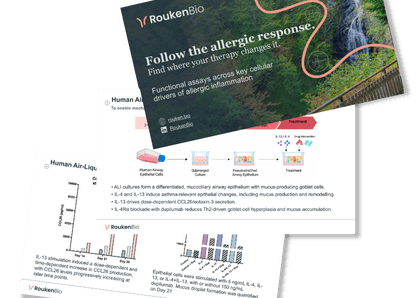
Access the slides
In vitro models allow different components of allergic inflammation to be examined independently, including IgE‑dependent basophil and mast‑cell activation, Th2, B‑cell and eosinophil responses, and tissue‑associated inflammation. These can be combined according to the mechanism of the therapeutic and the biological response under investigation.
Our allergy assay portfolio spans basophil, mast cell, IgE-mediated and Th2-driven biology, with models designed to support therapeutic evaluation.

🗓️ Stay informed with our monthly scientific newsletter, published on LinkedIn on the last Wednesday of each month.
These editions bring you the latest in drug development breakthroughs, industry trends, and expert insights from the brilliant minds at RoukenBio.
Subscribe today on LinkedIn
 Research Posters