
Dr Luke Muir
Associate Scientific Director

 Insights
|
July 10, 2026
|
5 min read
B cells are often introduced as the antibody producing arm of the adaptive immune system, but their influence on immune function extends well beyond antibody production. Through antigen presentation, cytokine secretion, and direct interactions with other immune cells, B cells can shape immune responses across both protective and pathological settings. RoukenBio’s previous B cell resources provide a broader background to this biology, including an introduction to the immune system’s B cells and their therapeutic potential.
In oncology, this biology is particularly nuanced. B cells can contribute to protective anti-tumour immunity, including through antibody mediated recognition of tumour associated antigens as well as antigen presentation to T cells. However, dysregulated or malignant B cell populations can also contribute to disease pathology, either as the malignant compartment itself or as part of a wider immune environment that supports tumour persistence.
This dual role makes B cells an important focus for immuno-oncology. Rather than viewing B cells as a uniform population, the field increasingly recognises them as active immune regulators, disease‑associated cellular targets and therapeutic entry points. For drug developers, this creates opportunities to design therapies that either harness beneficial B cell functions or selectively eliminate pathogenic or malignant B cell populations.
B cell malignancies arise when cells within the B lineage undergo malignant transformation. These diseases are particularly well suited to immune-targeted therapeutic approaches because malignant cells often retain lineage associated or differentiation associated surface markers. Targets including CD19, CD20, CD22 and FcRL5 can therefore provide routes to identify, engage or eliminate defined B cell populations.
CD19 remains one of the most established targets in B cell malignancies. The development of CD19 targeted CAR-T cell therapy was a major therapeutic breakthrough for B cell malignancies, although long-term disease-free survival remains a challenge in some settings. BCMA-targeted CAR-T therapies have also shown promising responses in multiple myeloma, although resistance and relapse are recognised challenges.
These examples illustrate a broader trend in oncology drug development: the continued movement from broad immune modulation towards more precise cellular targeting. In B cell malignancies, the central questions are no longer simply whether a therapy can kill B cells, but which B cells it kills, how completely it kills them, whether activity depends on target density, and whether non-malignant B cell populations are also affected.
Historically, many B cell depletion strategies have focused on broad lineage markers such as CD19 and CD20. While these targets remain highly relevant, next‑generation approaches are increasingly shifting towards more selective targeting of disease relevant B cell populations and markers with reduced susceptibility to antigen loss or modulation under therapeutic pressure. Some examples include BCMA in multiple myeloma and CD22 in B cell acute lymphoblastic leukaemia and non‑Hodgkin lymphoma, reflecting a growing emphasis on aligning target biology with disease context.
This shift is being driven by both efficacy and safety considerations. In oncology, broad B cell depletion may be appropriate in some contexts, particularly where malignant cells share canonical B cell lineage markers. However, more selective targeting may be desirable where developers need to maximise tumour cell killing while better understanding the potential impact on healthy B cell subsets. This is especially important for targets that are not exclusively tumour-restricted and may also be expressed across normal B cell differentiation states.
The therapeutic modalities used to achieve B cell depletion are also diversifying. These can include monoclonal antibodies, T cell engagers (TCEs), bispecific and multispecific antibodies, antibody-drug conjugates, CAR-T cells and other cell-based approaches.
As therapeutic strategies become more precise, the assays used to evaluate them must also evolve. A simple bulk depletion readout may be useful, but it is rarely sufficient on its own. Developers increasingly need assays that can connect target engagement, immune activation, cytotoxicity, donor variability, disease relevance and subset-level effects into a more complete translational picture.
B cell depletion assays need to address several distinct but interconnected questions. First, does the molecule deplete the intended target population? Second, does it engage and activate the expected effector mechanism? Third, does depletion vary across donors, disease states or B cell subsets? Finally, are there signals that may inform on‑target, off‑tumour biology or potential mechanisms of resistance?
RoukenBio’s B cell depletion platform is designed to support the translational assessment of B cell-directed therapies across clinically relevant assay formats, with subset-level resolution adding an additional layer of insight. At its core, the platform is built around primary human cell assays typically PBMC-based systems combined with multiparametric flow cytometry to quantify B cell depletion, subset-specific effects and effector cell activation within a single experimental framework. B cells represent a highly heterogeneous population; naïve, memory, switched memory, double-negative, plasmablast and plasma cell-like populations can differ significantly in target expression, abundance, disease relevance and susceptibility to depletion.
A key advantage of RoukenBio’s B cell depletion platform is its flexibility, enabling adaptation to the specific biological question or therapeutic modality. For early molecule characterisation, whole PBMC assays provide a physiologically relevant context in which endogenous B cell targets and effector populations (for example T cells for TCEs) are present within the same system and at natural proportions. For more focused mechanistic questions, the platform can incorporate purified cell populations, target expressing cell lines, malignant cell spike‑ins or disease relevant sample sources.
The platform supports deeper immunophenotyping. Established assay formats enable quantification of bulk B cell depletion and evaluation of depletion across phenotypically defined B cell subsets. This is important, as a single therapeutic may demonstrate differential activity across B cell compartments, with implications for therapeutic positioning, safety interpretation and patient selection strategies.
Disease relevant sample contexts can also be incorporated. For example, bone marrow mononuclear cells can be used to evaluate B cell targeting therapies within a bone marrow relevant environment, enabling assessment of activity against disease‑associated populations in haematological malignancies.
Taken together, this combination of primary cell biology, flexible assay design and high-resolution analysis provides a robust framework for translational evaluation. RoukenBio’s platform enables not only the determination of whether depletion occurs, but also a deeper understanding of how it occurs, which populations are affected, and how effector activation aligns with target cell killing.
Ultimately, the value of a B cell depletion assay lies in its ability to generate decision relevant data. RoukenBio’s platform is positioned to support key development questions, linking target engagement, functional depletion and immune activation within a single integrated framework to inform therapeutic potential, differentiation and clinical strategy.
For many B cell directed therapies, target expression level is a key determinant of activity. Molecules may demonstrate strong efficacy against cells with high antigen density but show reduced activity where expression is lower or heterogeneous. This distinction is particularly relevant when comparing malignant and non‑malignant populations, or when defining the receptor threshold required for effective immune engagement.
Roukenbio’s IndEx‑2 platform is a dual‑inducible cell line system that enables independent control of antigen expression, allowing receptor levels to be precisely modulated from hundreds to tens of thousands of copies per cell on defined cellular backgrounds. This facilitates robust receptor thresholding characterisation across binding and cytotoxicity endpoints, which can also be integrated with our xCELLigence RTCA platform to capture both kinetic and threshold dependent activity in real time. To support translation into biologically relevant systems, RoukenBio also routinely performs receptor quantification across primary immune subsets, enabling alignment between engineered models and endogenous expression profiles. Pre‑developed systems are available for key B cell targets including but not limited to BCMA, CD19 and FcRL5.
Within B cell directed oncology programmes, this approach provides a valuable complement to primary cell assays. While PBMC based and disease‑relevant models enable assessment in complex biological systems, inducible expression platforms allow precise dissection of how antigen density influences immune engagement, activation and cytotoxic function.
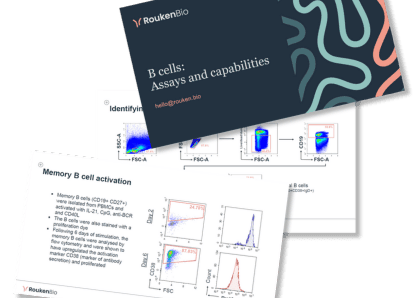
Access the slides
🗓️ Stay informed with our monthly scientific newsletter, published on LinkedIn on the last Wednesday of each month.
These editions bring you the latest in drug development breakthroughs, industry trends, and expert insights from the brilliant minds at RoukenBio.
Subscribe today on LinkedInLearn more about B cell assays via real data.


 Technical Presentations