Surface Plasmon Resonance (SPR) is a real-time, label-free, gold-standard technology used throughout the drug development life cycle for monitoring and characterising molecular interactions. At RoukenBio, we enhance the in-depth characterisation of your therapeutic. We start with initial studies to understand the mechanism of action, demonstrating the molecule's binding to its intended target(s). We then progress to late-stage development, where critical quality attributes are established.
Our SPR assays are developed in-house, giving our scientists a deep understanding of the development process, what works technically (and what doesn’t), and how best to tailor the assay to address your specific scientific questions. Our dedicated team is driven by scientific empathy and united by a passion for solving complexities and overcoming challenges to deliver exceptional results for your project.
Direct Target Binding
Binding Dependence
Epitope Binning
Affinity Screening
FcR and C1q binding
Concentration Determination
Our state-of-the-art Biacore 8K instruments enable us to deliver precise analysis of molecular interactions. RoukenBio has established a range of optimised SPR assays that evaluate protein-protein and protein-small molecule interactions which can be used across the drug discovery life cycle including high throughput early ranking studies to identify candidates of the required characteristics through to highly robust assessments that deliver exceptional accuracy. Through direct binding assays, we provide detailed analysis of interaction parameters, including association/dissociation rates and equilibrium constants under near-physiological conditions.
These assays can be considered as “plug and play” once the optimum setup conditions have been established for new molecules and standard customisation protocols are available to quickly establish new methods. With high sensitivity, reproducibility and expert data analysis, we provide actionable insights for your research and development goals.
Pre-developed assays are available for the following target antigens:
Our state-of-the-art Biacore 8K instruments enable us to deliver precise analysis of molecular interactions. RoukenBio has established a range of optimised SPR assays that evaluate protein-protein and protein-small molecule interactions which can be used across the drug discovery life cycle including high throughput early ranking studies to identify candidates of the required characteristics through to highly robust assessments that deliver exceptional accuracy. Through direct binding assays, we provide detailed analysis of interaction parameters, including association/dissociation rates and equilibrium constants under near-physiological conditions.
These assays can be considered as “plug and play” once the optimum setup conditions have been established for new molecules and standard customisation protocols are available to quickly establish new methods. With high sensitivity, reproducibility and expert data analysis, we provide actionable insights for your research and development goals.
Pre-developed assays are available for the following target antigens:
Differential affinity is key to maximising the therapeutic window of immune cell engagers. Have you considered how single occupation of an antibody binding domain may affect an in ‘cis’ interaction? This is especially relevant to T cell engagers, where target antigen binding can influence the kinetics of the interaction of the anti-CD3 arm with the T cell. Understanding binding dependencies is critical for the prediction of functional activity and extends beyond immune cell engagers to all classes of bispecific and multispecific antibodies and even conventional monoclonals. Our dependent binding assessments can be applied to T cell engagers, bispecifics and even to determine how the Fab-antigen interaction of an IgG1 molecule may affect the interaction of the Fc domain with Fc receptors. We have established a range of SPR assay designs to interrogate these dependencies. These can be applied across the drug discovery life cycle.
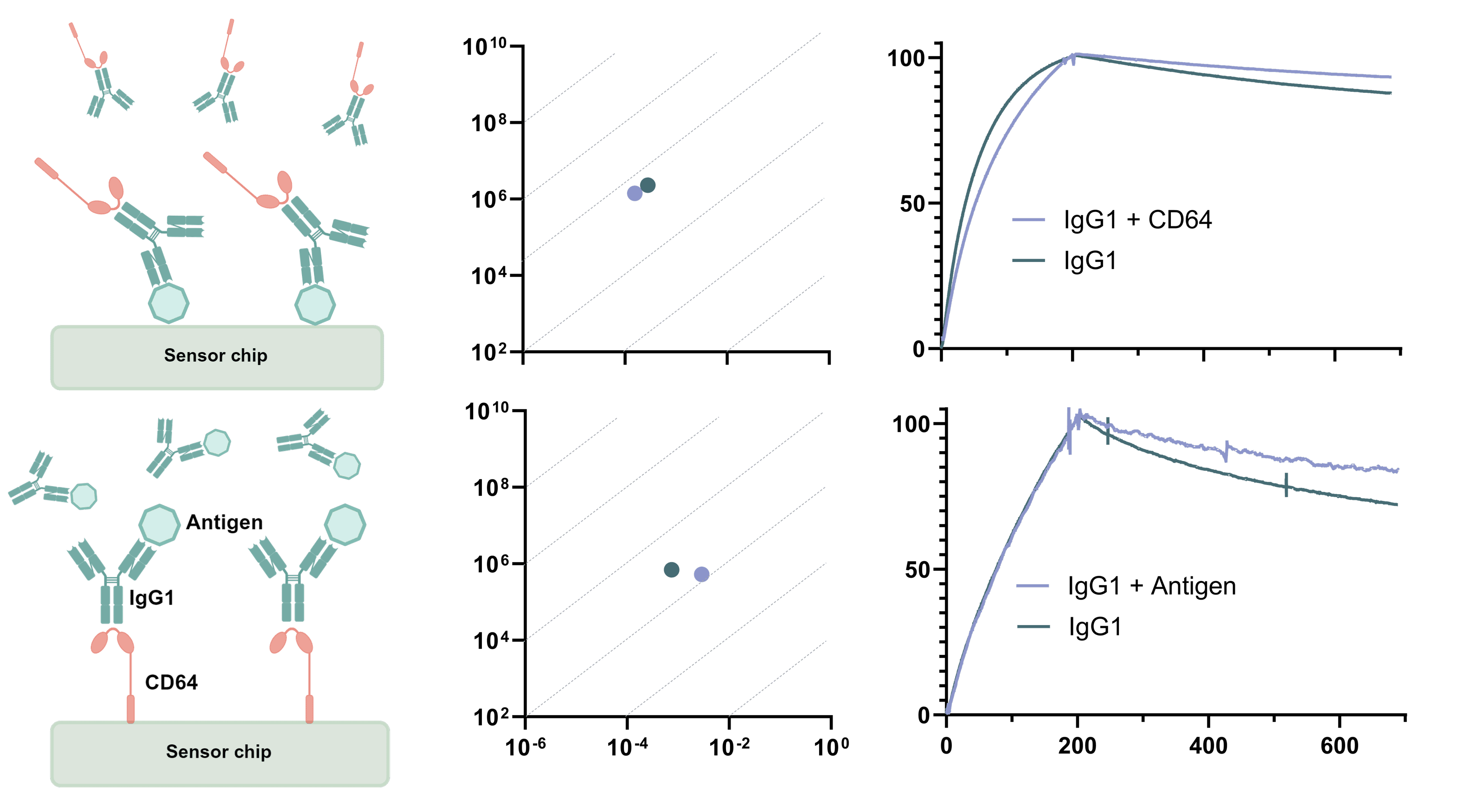
IgG1-CD64 complexes bind PD1 with similar affinity while IgG1-antigen complexes bind CD64 with differential affinity.
The development of biologically active drugs requires effective tools that allow for the characterisation of epitope coverage and affinity. Early-stage screening of antibody candidates in a library using epitope binning allows antibodies to be competitively assessed against all other antibodies in the library to determine which antibodies block the same epitopes on a target antigen. A blocking profile can be determined for each antibody, and those with similar blocking profiles are then ‘binned’ or grouped together. In this way, molecules that target a specific epitope on an antigen can be engineered and developed rather than selecting only those initial high affinity molecules that may not target multiple and distinct epitopes. This maintains diversity in selection and ensures that the best performing antibodies in each bin can be selected for development.
Tandem assay design is a preferred method for binning as it minimises sample consumption. Two antibodies are bound, one after the other to test if one antibody blocks binding of the other to the immobilised antigen.
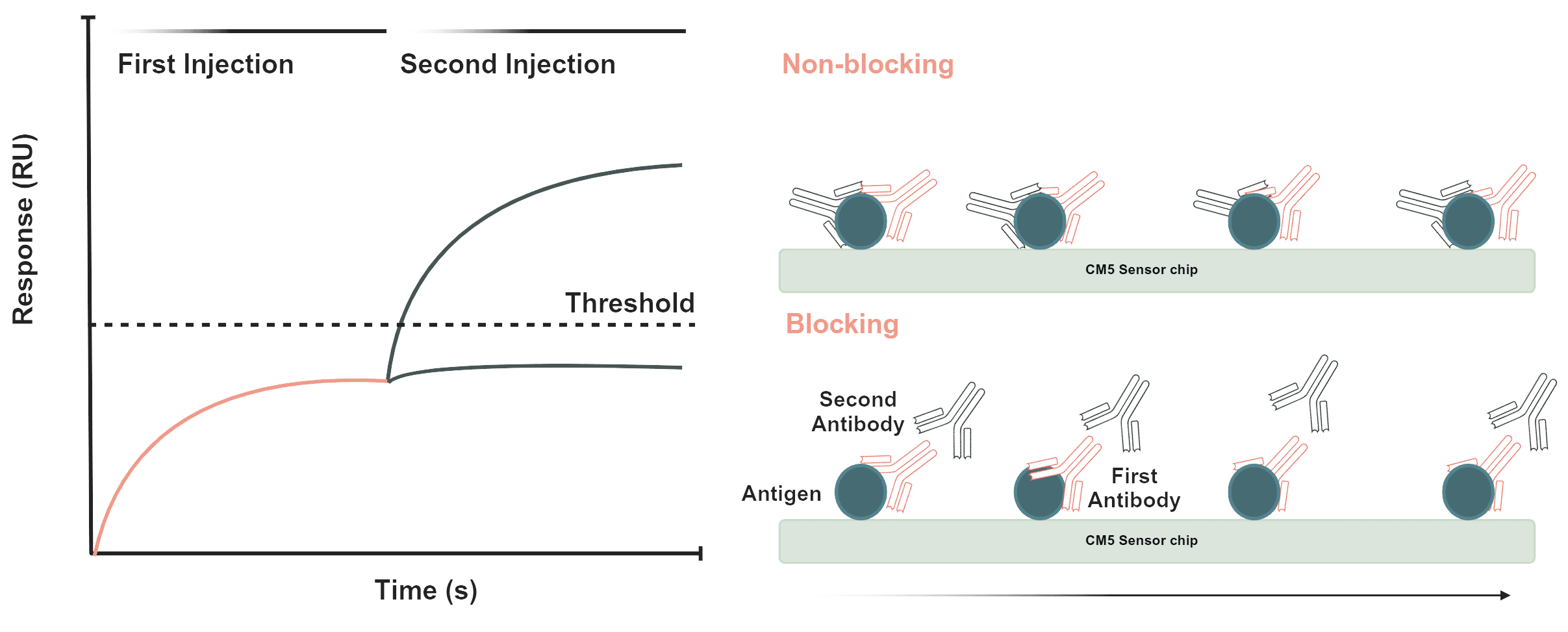
Tandem assay design.
Antibody screening identifies clones that produce antibodies exhibiting the specific kinetic characteristics required for further development. Analysis can be performed directly on complex sample matrices such as cell culture supernatants to answer early questions regarding expression levels, target specificity and binding stability. The data generated can then be used to make informed decisions around clonal selection and the selected candidates can be further interrogated using our epitope binning assays and/or kinetic and affinity assays.
Report point screen:
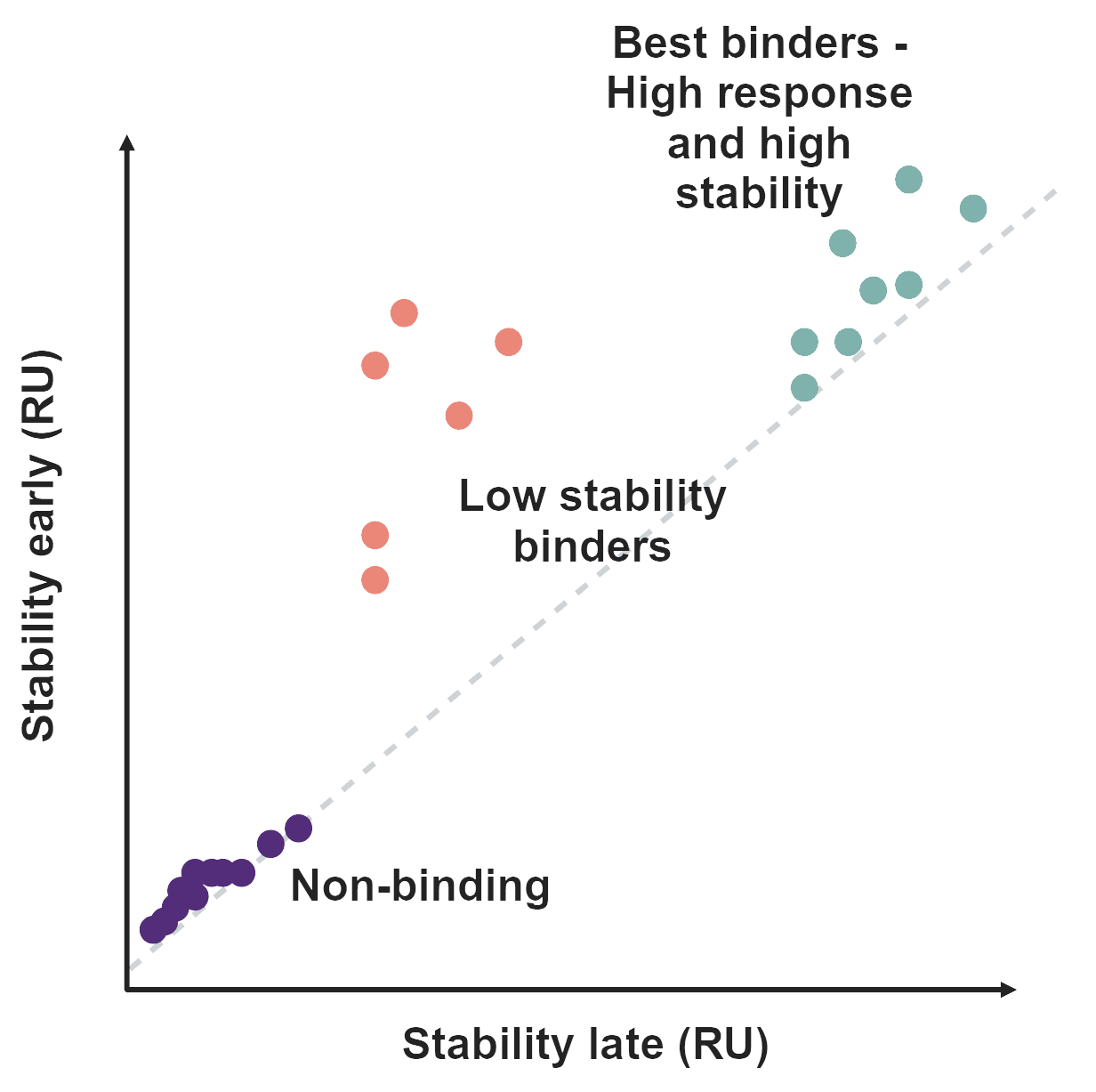
Report point high affinity screen to elucidate non-binders, low stability binders and best binders.
Kinetic Screen:
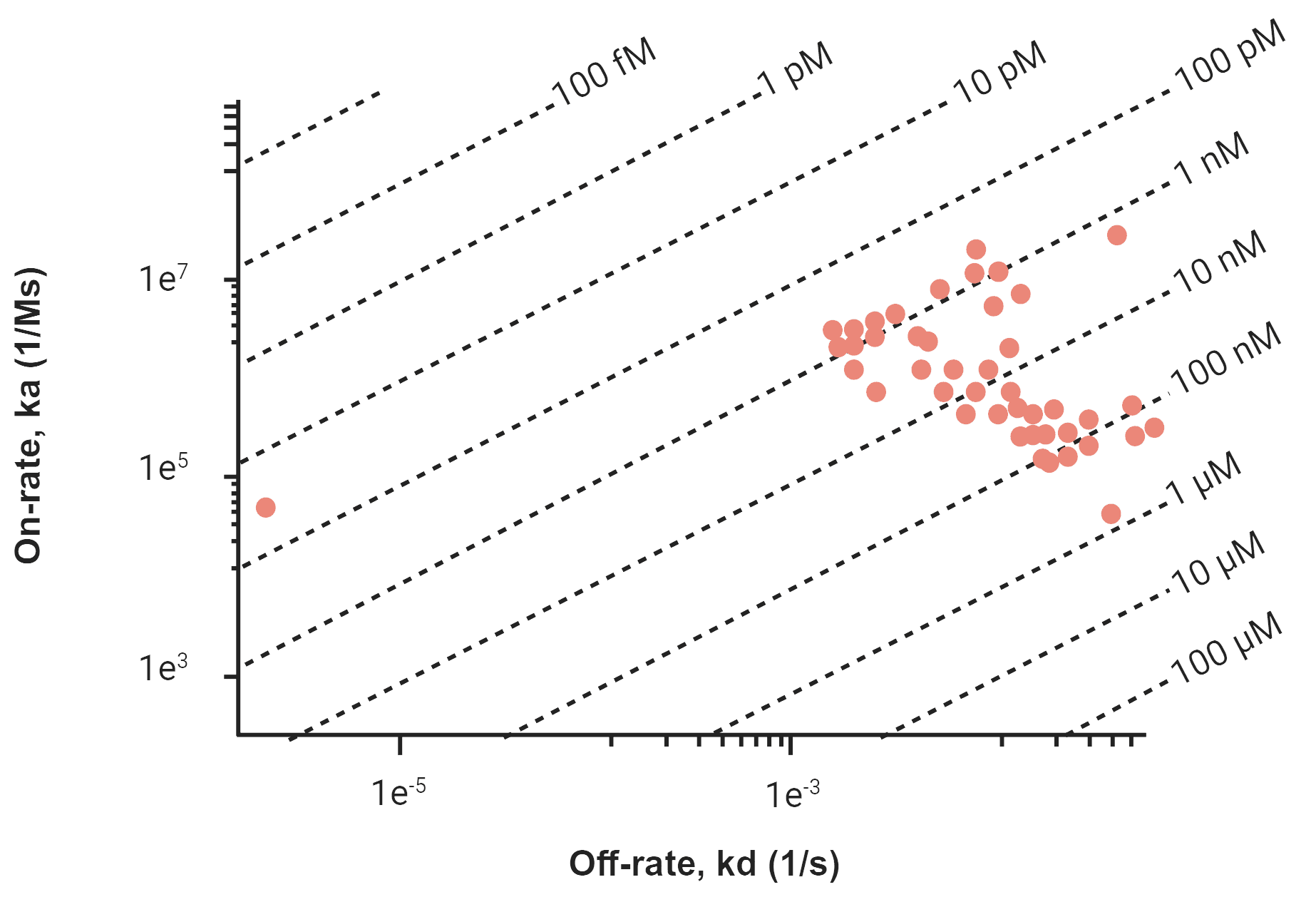
On-off rate chart showing antibodies with the same affinity lying on the same diagonal but clearly showing different rates of binding and association.
RoukenBio has established a range of optimised assays that evaluate the interactions of antibody therapeutics against panels of human, mouse and/or cynomolgus monkey Fcγ receptors and FcRn. In addition is the assay that measures the interaction of antibody therapeutics and compliment component C1q. All assays are conducted using high quality receptors that are produced and quality controlled in-house.
Fc Receptors available:
Human | Cynomolgus | Murine |
FcγRI (CD64) | FcγRI (CD64) | FcγRI (CD64) |
FcγRIIa (CD32a H variant) | FcγRIIa (CD32a) | FcγRIIb (CD32b) |
FcγRIIa (CD32a R variant) | FcγRIIb (CD32b) | FcγRIII (CD16) |
FcγRIIb (CD32b) | FcγRIII (CD16) | FcγRIV (CD16-2) |
FcγRIIIa (CD16a V variant) | FcRn | FcRn |
FcγRIIIa (CD16a F variant) | ||
FcγRIIIb (CD16b) | ||
FcRn |
The methodologies can be used across the drug discovery life cycle including early ranking studies to identify candidates that have been successfully silenced, more robust methods to understand if design modifications elicit the required response through to highly robust assessments that deliver exceptional accuracy. Having been in your shoes ourselves, we have a clear understanding of the challenges surrounding FcR binding methodologies – so we can provide the exact support required to achieve your goals.
It is often pertinent to determine not only the total concentration of a protein but also the concentration that is specifically related to the function and/or activity of a protein. We can precisely quantify the amount of active protein over a dynamic range, especially useful for stability studies.
Download our technical slides to learn more about the SPR Capabilities at RoukenBio. Access sample data and boost your drug discovery goals.